Explanation of the 6 Preset Strategies to Help Create Your CCL Strategy

2026-05-14 — 6 min read
Custom Concentrated Liquidity is now live on Rujira.
To help you get started, we include 6 preset strategies, from passive and wide to tighter and more directional setups.
Not sure which CCL range to choose?
Here is what each one means and how you can use them.
FAQ
- What is Custom Concentrated Liquidity on Rujira?
Custom Concentrated Liquidity, or CCL, lets you choose the price range where your liquidity is active. Instead of spreading liquidity across the entire price curve, you can concentrate it within a specific range based on your market view.
- Which CCL preset should I choose?
That depends on how actively you want to manage your position and what you expect the market to do. Passive and Wide cover broader ranges, Tight concentrates liquidity closer to recent price action, while One-sided Lower and One-sided Higher are designed for more directional strategies. Copy will also allow users to follow the range of a top-performing strategy once it goes live.
- What happens when price moves through my range?
As price moves through your selected range, the composition of your position changes automatically. Toward the lower end, you hold more of the base asset. Toward the upper end, you hold more of the quote asset. If price moves completely outside the range, your position becomes fully concentrated in one of the two assets until price moves back into the range.
First, understand the CCL range itself
Before looking at the presets, it helps to understand the CCL range itself.
Your lower range is the price where you are comfortable being 100% in the base asset, for example BTC. You will be averaging down between the price at the time you create your range and the low you set.
Your upper range is the price where you are comfortable being 100% in the quote asset, for example USDC. You will be taking profit between the price at the time you create your range and the high you set.
Between those two levels, depending on market volatility and spread, your liquidity works automatically as price moves through the range.
Let’s look at the 6 presets below.
⚡️ Passive
Range: around -99.5% to +2000%
This is the broadest preset and the one closest to an XYK-style strategy, while still being more capital efficient than XYK. It is designed for people who want a more set-and-forget approach and do not want to adjust often.
Because your liquidity is spread so wide, it is usually less efficient than tighter ranges, but it gives you broad market coverage.
When to use Passive
This can make sense if you want simple exposure, expect a lot of uncertainty, or prefer convenience over optimization.
It is usually the easiest starting point, but not the best choice if you want to be more active or aim for higher capital efficiency.
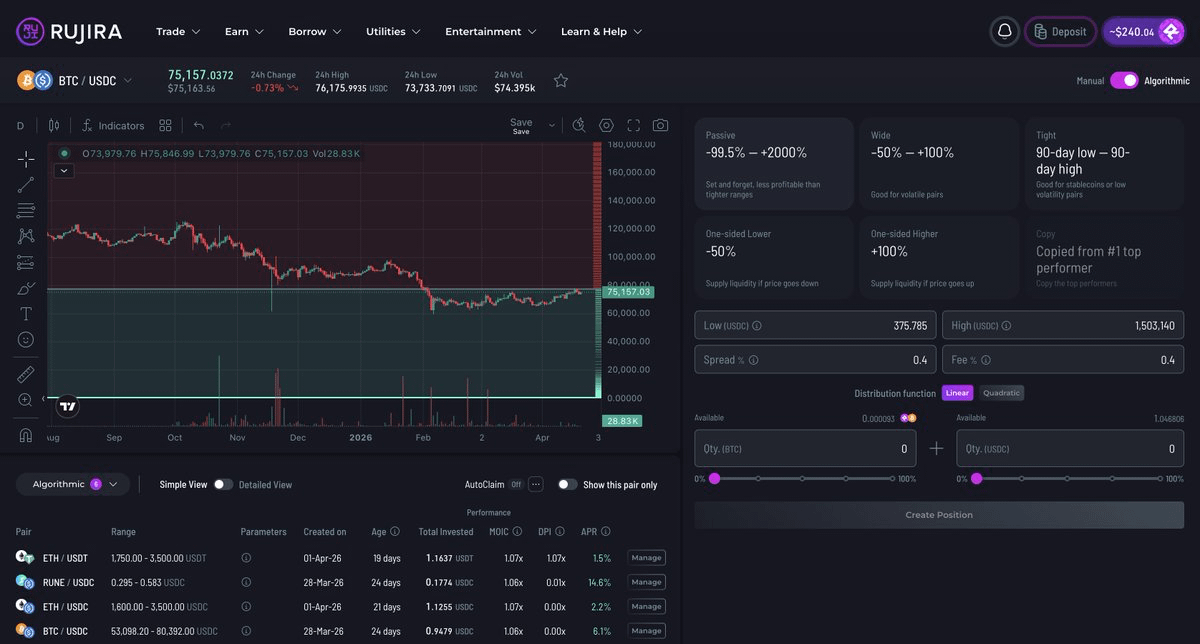
⚡️ Wide
Range: around -50% to +100%
This preset is made for more volatile pairs.
It gives your strategy room to stay active across larger price swings, while still being more focused than a fully passive setup.
When to use Wide
This can fit when you expect meaningful volatility but still want your liquidity to remain useful across a broad zone.
It is a balanced option for people who want more efficiency than Passive, without going so tight that the range is easy to leave.
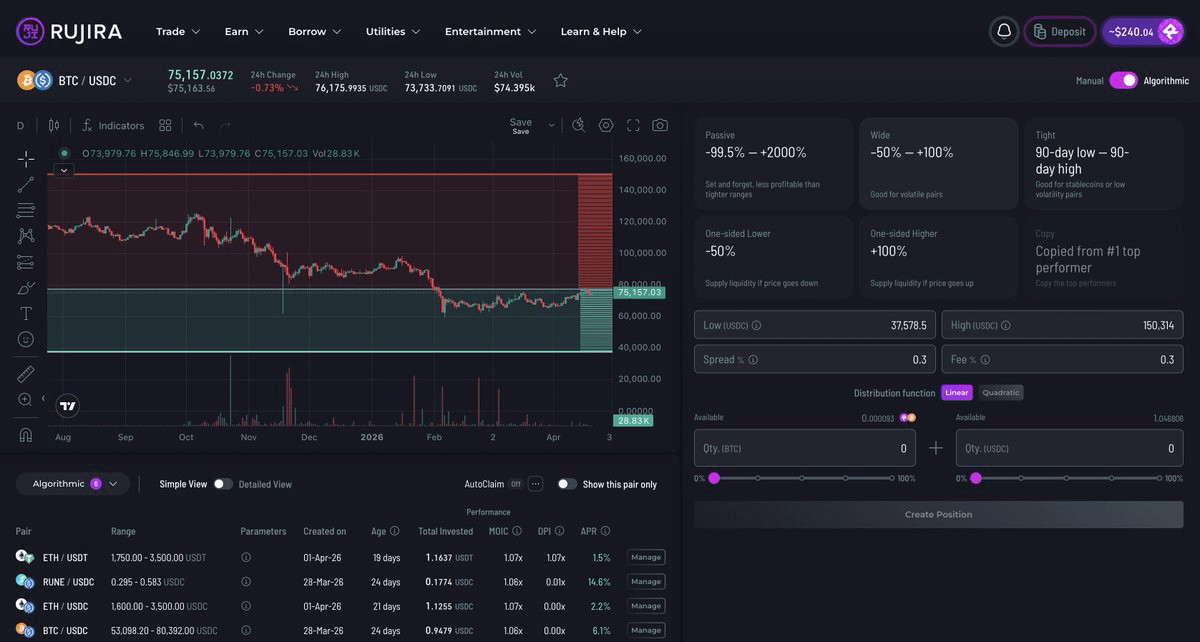
⚡️ Tight
Range: 90-day low to 90-day high
This preset keeps liquidity closer to the price action. It is often a better fit for stablecoins or correlated assets like BTC/WBTC, where price tends to move within a more contained range.
A tighter range can improve capital efficiency while price stays inside it.
When to use Tight
This can work well when you expect calmer market conditions or when the pair is naturally more stable.
It is less forgiving than a wide range, but can be more efficient if your market view is right.
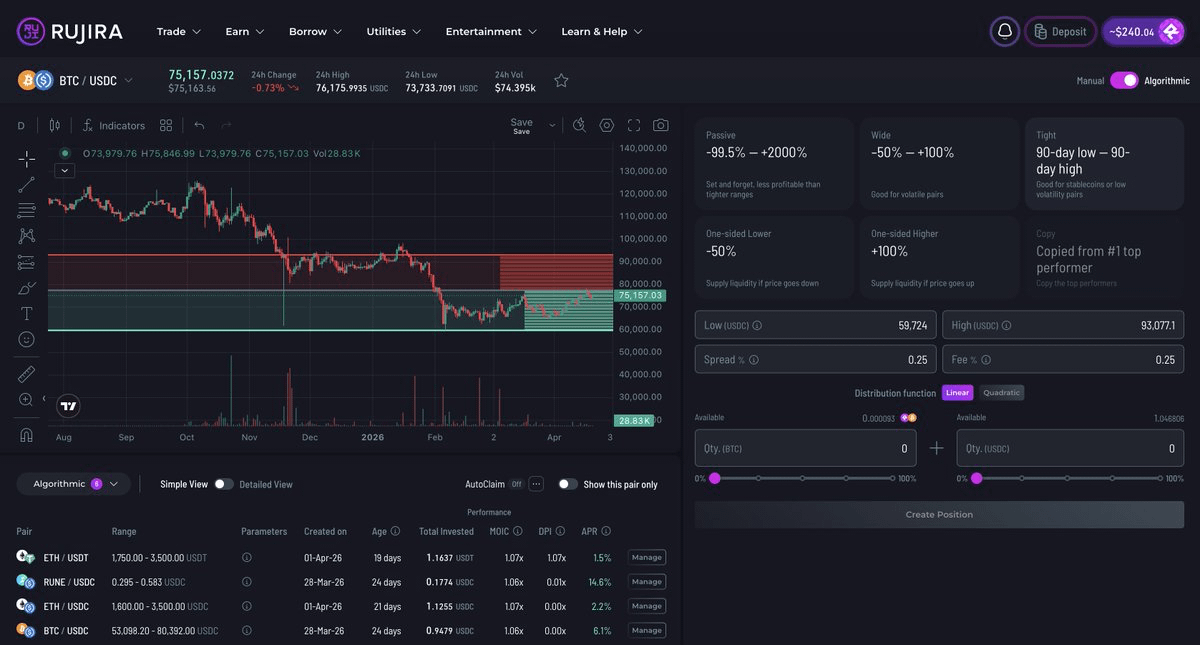
⚡️ One-sided Lower
Range: lower side only, around -50%**
This preset is for people who want to build a position and provide liquidity if price moves down.
In simple terms, you are positioning your strategy so it becomes more active lower in the range, where you would be comfortable accumulating more of the base asset.
When to use One-sided Lower
This can make sense if you would be happy buying into weakness or adding exposure consistently at lower prices.
It is useful when you have a bullish long-term view and want your liquidity positioned to work if the market dips.
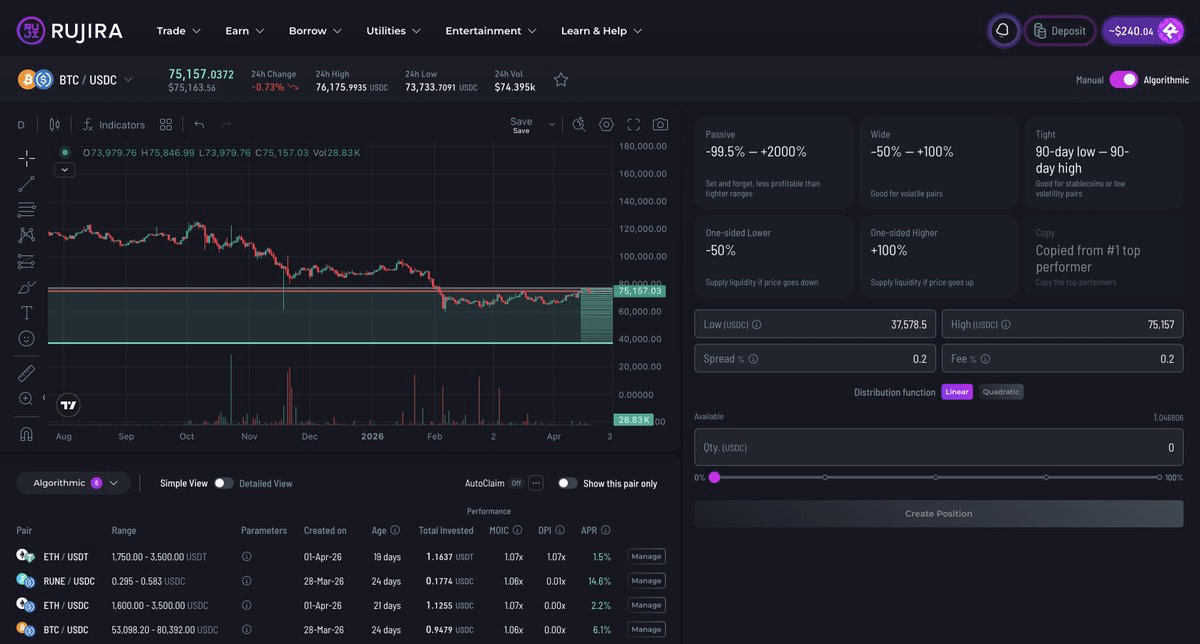
⚡️ One-sided Higher
Range: upper side only, around +100%
This preset is for people who want to take profit and provide liquidity if price moves up.
It is a more directional setup for those who are comfortable selling more of the base asset into strength and becoming more positioned in the quote asset higher up.
When to use One-sided Higher
This can fit if you expect price to move upward and are comfortable reducing exposure or taking profit consistently into that direction.
It is useful when you want liquidity to become active higher in the range, instead of using a balanced setup around the current price.
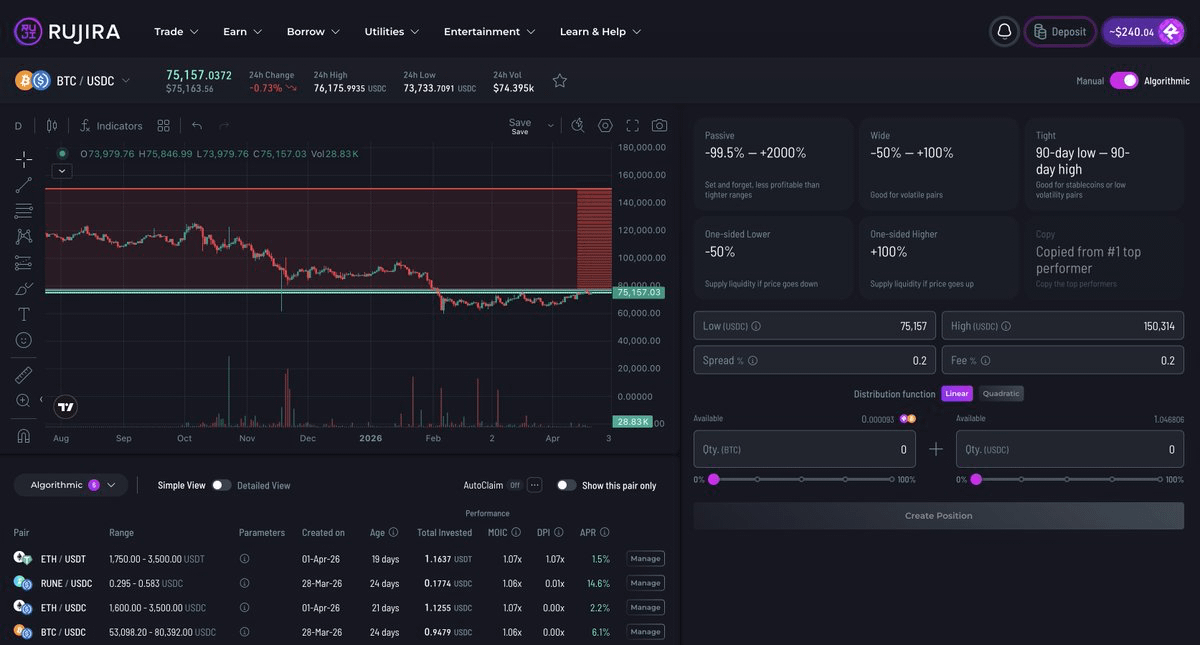
⚡️ Copy (coming soon)
Copied from the current top performer
This preset lets you copy the range and parameters from the most profitable strategies.
It can be helpful for discovering how the top performer is positioned, especially if you are still learning how range selection works.
When to use Copy
This can be a useful reference point, but it is still important to understand what you are copying.
A top-performing setup in one market condition may not be the best fit for the next one, so it helps to treat this as guidance, not autopilot.
A simple way to get started with CCL
The preset strategies are a great way to get started with CCL and an entry point to help you become comfortable with market making.
More information about CCL is available in our CCL launch article.
With CCL, we give you more control over how your capital can work.
Our 6 presets make CCL easier to understand, easier to access, and easier to shape into a strategy that fits your own market view.
Which preset would you start with first, or would you rather set your own custom range?

Related articles
![Protocol Update Podcast with Chad Barraford, Kenton and Denny]()
Oct. 15, 2026
SwapKit Rev-Share Week One: Early Data Looks Promising, v3.21 and Monero Next
- Podcast
![THORChain editorial thumbnail about centralized exchanges shutting down in 2026 and swapping across blockchains from a self-custody wallet.]()
Oct. 14, 2026
Why Exchange Closures Make the Case for THORChain
- Editorial
![THORChain Protocol Spotlight thumbnail for FaustSwap, a BTC to XMR swap aggregator]()
Oct. 12, 2026
Protocol Spotlight - FaustSwap
- Spotlight
![Ecosystem Update Podcast with Zano]()
Oct. 10, 2026
Zano’s Recovery Plan and the Road to THORChain
- Podcast
![A mint green notification bell glyph on a black key, cover of THORChain's guide to its official channels, podcasts and social media.]()
Oct. 9, 2026
How to Stay Up to Date With THORChain
- Guide
![Protocol Update Podcast with Chad Barraford, Kenton and Patriot]()
Oct. 8, 2026
Chad's Unchained Podcast Debrief, Rev-Share and Monero
- Podcast
![Zcash (ZEC) logo alongside the THORChain logo, illustrating native ZEC swaps across blockchains on THORChain.]()
Oct. 7, 2026
Bringing Native Zcash to THORChain
- Guide
![State of Network - September 2026 thumbnail.]()
Oct. 6, 2026
State of the Network - September 2026
- Report
![boone.tools logo on a dark THORChain background, introducing Boone's collection of THORChain analytics dashboards.]()
Oct. 5, 2026
Introducing boone.tools: A Better Way to Understand THORChain
- Spotlight
- Guide
![Ecosystem Update Podcast with Houdini Swap]()
Oct. 3, 2026
Houdini Swap on THORChain Explained: What It Means for Users and Treasury Revenue
- Podcast
![Protocol Update Podcast with Chad Barraford, Kenton and Denny]()
Oct. 1, 2026
Can or Should THORChain Censor Transactions?
- Podcast
![Protocol Update Podcast with Chad Barraford, Kenton, Devel and Boone]()
Sep. 24, 2026
Inside the Houdini Swap Debate: THORChain’s Treasury, Privacy and Revenue
- Podcast
![THORChain's System Income distribution, with 20% now directed to Protocol-Owned Liquidity and the RUNE burn reduced to 1%.]()
Sep. 23, 2026
How THORChain’s New System Income Distribution Works
- Guide
![Illustration of THORChain's Protocol-Owned Liquidity system, showing System Income flowing into deeper liquidity pools.]()
Sep. 21, 2026
Why Protocol-Owned Liquidity Matters for THORChain
- Guide
![Ecosystem Update Podcast with Radix]()
Sep. 19, 2026
Radix and THORChain: Building Trust for the Agentic Future
- Podcast