When people hear that THORChain is integrating Monero or other privacy chains, a common concern is if this makes activity harder to trace.
The answer is no. While privacy chains such as Monero and Zcash are designed to conceal transaction details, THORChain doesn't become a black box when interacting with them. The key distinction is between what happens on the privacy chain and what remains publicly recorded on THORChain itself.
THORChain Is Its Own Ledger
THORChain maintains its own record of every swap, along with its own on-chain state, which anyone can access.
Whenever a swap is executed, liquidity is added or removed, a fee is collected, or a vault balance changes, the event is recorded on THORChain and is publicly observable.
This is true regardless of which chains are involved. Swapping BTC for ETH creates a public record on THORChain. Swapping XMR for BTC creates the same type of public record, as the swap can still be observed through THORChain’s on-chain state and witness transactions.

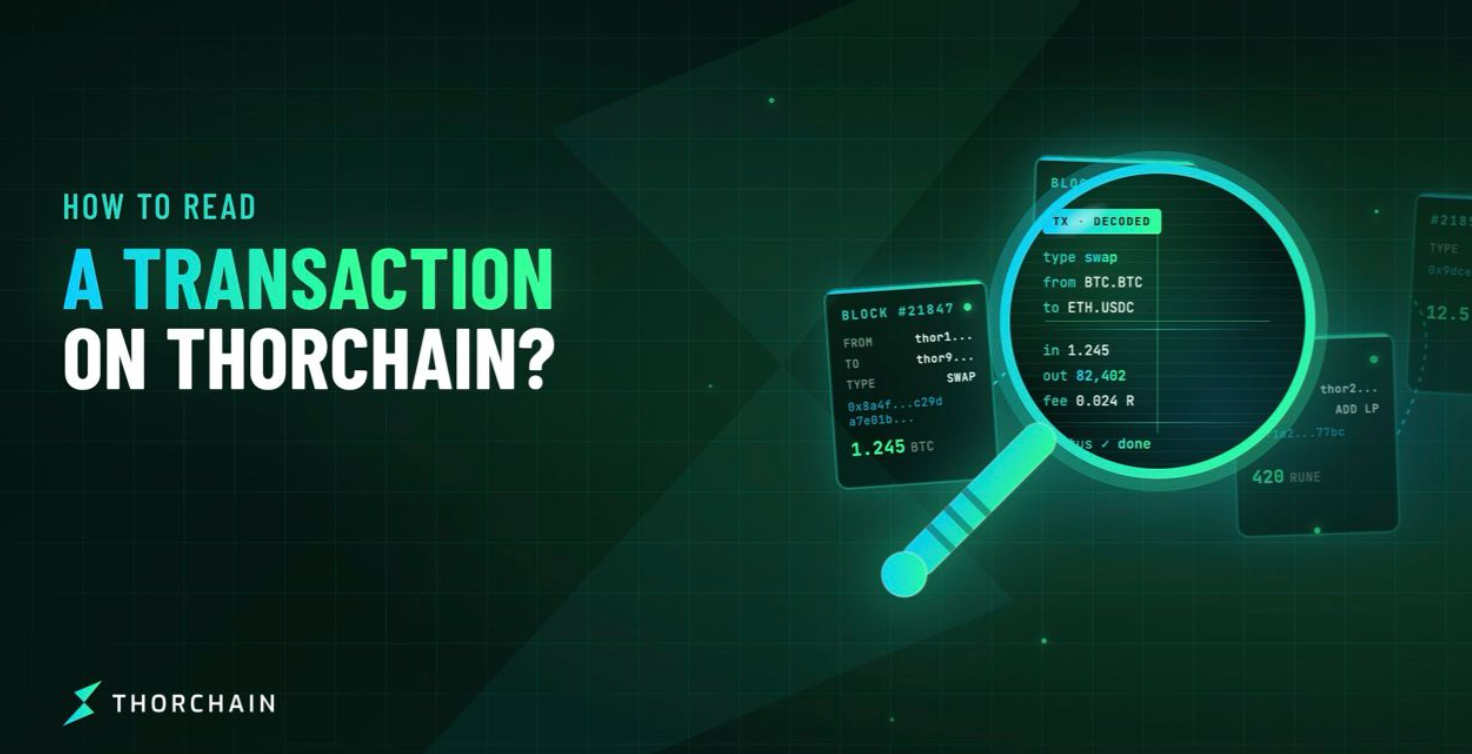
All of this information is available across various block explorers. For example, on the THORChain Explorer , we can see the network’s latest transactions, including the transaction ID, assets swapped, amounts, originating signer, and even the route provider.

What THORChain Sees Of Private Coins
When it comes to privacy coins, a useful way to think about THORChain is as the exchange counter, not the destination wallet.
When someone swaps into XMR, the exchange itself is public. THORChain records that a swap occurred, what was sent in, what was sent out, and to which address. What happens on the Monero blockchain after that point is governed by the Monero protocol, not THORChain.
While Monero hides transaction details by default on its own blockchain, interacting with THORChain is different. THORChain nodes must be able to verify inbound and outbound transactions to reach consensus, so the integration was designed to make this data visible.
For every XMR vault, THORChain nodes share the vault’s private view key. This allows each node to scan the Monero blockchain and independently verify incoming transactions. When an outbound XMR payment is made, nodes share the output key images, which prove which outputs were spent, along with the transaction details. This allows every node to confirm that the payment was constructed correctly and broadcast successfully.

All of this is recorded in THORChain’s consensus state. Every inbound transaction, outbound transaction, and swap memo is visible to the network and logged on-chain. THORChain itself doesn’t participate in extending the privacy offered by Monero through its own network.
The Mixing Happens Elsewhere, Not On THORChain
On a privacy coin like Monero, privacy is built directly into the protocol. Every transaction uses ring signatures, which combine the real sender’s signature with several others drawn from the blockchain. As a result, an outside observer cannot determine which signature belongs to the actual sender.

Stealth addresses protect the recipient in a similar way. Rather than recording the recipient’s public address onchain, Monero generates a unique one-time address for each payment that only the intended recipient can identify and access. RingCT completes the privacy model by concealing the amount being transferred.

Together, these features make it impossible to determine who sent funds, who received them, or how much was transferred from the public blockchain alone.
The outcome is functionally similar to what mixing tools aim to achieve on transparent blockchains. Bitcoin CoinJoin implementations, such as Wasabi Wallet, combine transactions from multiple users to make specific inputs and outputs more difficult to connect. Ethereum-based tools such as Tornado Cash and Railgun use smart contracts and pooled funds to obscure the onchain link between deposit and withdrawal addresses.
The key difference is that Monero provides these protections automatically at the protocol level for every transaction, rather than relying on an optional privacy tool added on top of a transparent network.
Nothing Is Hidden in the Protocol
Some protocols achieve privacy by obscuring their own internal state. THORChain doesn't and never has.
From THORChain’s perspective, swapping into XMR is no different from swapping into any other supported asset. The swap and settlement remain publicly visible on THORChain. Its node software is open source, the blockchain is publicly queryable, and key metrics,including vault balances, swap volumes, liquidity depths, fees, and protocol revenue, can be monitored in real time. What the recipient chooses to do with those funds once they arrive on the destination network falls outside the protocol’s scope.
Supporting Monero and Zcash therefore does not make THORChain more opaque. It simply expands the range of assets that can be traded on the protocol.
And that distinction is essential: THORChain can support privacy-focused assets without becoming a privacy protocol itself.

Related articles
![A mint green notification bell glyph on a black key, cover of THORChain's guide to its official channels, podcasts and social media.]()
Oct. 9, 2026
How to Stay Up to Date With THORChain
- Guide
![Zcash (ZEC) logo alongside the THORChain logo, illustrating native ZEC swaps across blockchains on THORChain.]()
Oct. 7, 2026
Bringing Native Zcash to THORChain
- Guide
![boone.tools logo on a dark THORChain background, introducing Boone's collection of THORChain analytics dashboards.]()
Oct. 5, 2026
Introducing boone.tools: A Better Way to Understand THORChain
- Spotlight
- Guide
![THORChain's System Income distribution, with 20% now directed to Protocol-Owned Liquidity and the RUNE burn reduced to 1%.]()
Sep. 23, 2026
How THORChain’s New System Income Distribution Works
- Guide
![Illustration of THORChain's Protocol-Owned Liquidity system, showing System Income flowing into deeper liquidity pools.]()
Sep. 21, 2026
Why Protocol-Owned Liquidity Matters for THORChain
- Guide
![How to Swap Crypto on THORChain thumbnail, a THORChain guide]()
Sep. 18, 2026
How to Swap Crypto on THORChain
- Guide
![THORChain Thumbnail for the 2026 guide comparing ten decentralized exchanges across cross-chain support, fees and MEV protection.]()
Sep. 10, 2026
The 10 Best Decentralized Exchanges (DEXs) in 2026
- Guide
![Thumbnail for THORChain guide explaining how the Advanced Swap Queue and slip-based fees prevent sandwich attacks on swaps.]()
Sep. 7, 2026
How THORChain’s Swap Queue Prevents Sandwich Attacks
- Guide
![THORChain guide thumbnail explaining how to bond RUNE through direct whitelisting, RUNEBond and bRUNE liquid staking, with yield and risk comparisons for each method.]()
Sep. 2, 2026
How to Bond your Rune: a practical guide
- Guide
![THORChain guide thumbnail showing how to perform a cross-chain swap without connecting a wallet, using the Walletless Swap feature on swap.thorchain.org.]()
Aug. 12, 2026
How To: Walletless Swaps
- Guide
![THORChain Community Podcast #198 thumbnail featuring JP and Kenton demonstrating the first live decentralised RUNE to Monero swap on THORChain's chainnet.]()
May. 14, 2026
JP Demos Live Monero on THORChain: 7 Nodes, Real Funds, First Swap Works
- Podcast
- Guide
![]()
Apr. 22, 2026
How to read a transaction on THORChain?
- Guide
![]()
Apr. 16, 2026
THORChain’s Native API - plugging liquidity directly to wallets and DEXs
- Guide
![]()
Nov. 26, 2025
Memoless Transactions - THORChain Without Wallet Limitations
- Guide
![]()
Oct. 29, 2025
Advanced Swap Queue & Limit Swaps
- Guide