BEPSwap Pools
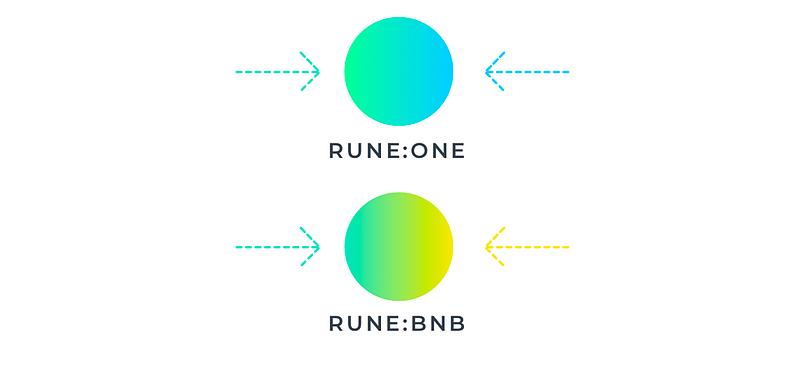
One of the key aspects of BEPSwap’s liquidity pools is that it is completely price-nuetral. BEPSwap does not impose a price on pools, the market decides to price the pools and the ratio of assets in the pools adjust accordingly.
Thus users can stake asymmetrically, where they can stake as little or as much assets as they like. They may do this simply because they deem the cost of switching assets is too high, or they think they can stake in a pool AND correct the price at the same time.
When staking asymmetrically, the user simply sends in assets to a pool in a valid staking transaction and the statechain updates pool balances and stake units accordingly.
The formula for calculating ownership of a pool is:
((R + T) (r T + R t))/(4 R T)
- R: Rune Balance after staking
- r: Rune staked
- T: Token Balance after staking
- t: Token staked
As can be seen, as long as either r or t is non-zero, then the stake units can be calculated. The staker now owns an equal share of both sides of the pool.
As the pool accrues fees, the staker gets to earn those fees as well, through ownership of the pool and everything in it.
Withdrawing
When the staker goes to withdraw, the statechain allows them to specify three parameters:
- Asset : Asset, such as BNB.XRP
- W : Withdraw Basis Points
- A : Asymmetry
WITHDRAW:BNB.XRP:10000:1.0
Withdraw Basis Points
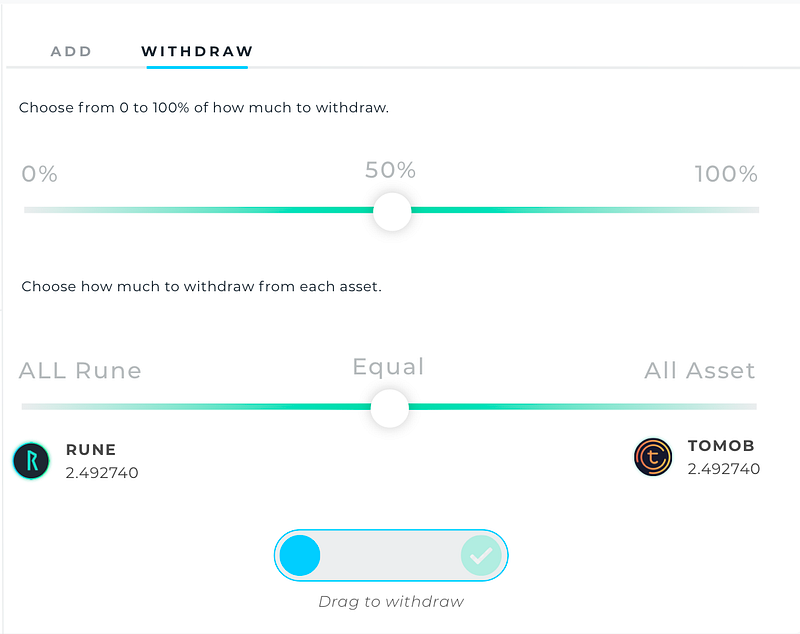
This allows them to set units from 0 to 10000 (100%) in how much they want to withdraw, which is very precise. This is envisaged to be used by staking pools, exchanges and stakers withdrawing daily earned fees, which can be small.
Asymmetry
The third parameter is the asymmetry, which allows them to set how they want to withdraw, from -1 to 1 or any decimal place in-between.
- Setting -1.0 means they will withdraw 100% in Rune.
- Setting 0 or blank, means they will withdraw equally on both sides
- Setting 1.0 means they will withdraw 100% in the asset.
They can also set any amount of partial withdrawals, such as 0.42 which is 60% in the token and 40% in Rune.
The equation to do this is given by:
(S * R * W * ((-1*A* (P - S * W)^2) / (P * ((-1*A-1) * S * W + P)^2) + 1/P))
- S: Stake Units
- P: Pool Units
Conceptually, this is a withdrawal of everything, followed immediately by a swap of the desired amount. The equation that accounts for the parameters above as well as the XYK formula.
Considerations
The only consideration to have, is that by doing an asymmetric stake or withdrawal that shifts the pool price away from market price, it means the staker will be exposed to arbitrage as the market corrects.
Having said that, the total amount of arbitrage cost will be the same as if they had performed a swap at the same time. Additionally this cost becomes negligible at when the pools become very deep in liquidity.
The team look forward to seeing the community build on these features.
Community
Stay in touch!
- Twitter: https://twitter.com/thorchain_org
- Telegram Community: https://t.me/thorchain_org
- Telegram Announcements: https://t.me/thorchain
- Reddit: https://reddit.com/r/thorchain
- Github: https://github.com/thorchain
- Medium: https://medium.com/thorchain

Related articles
![A mint green notification bell glyph on a black key, cover of THORChain's guide to its official channels, podcasts and social media.]()
Oct. 9, 2026
How to Stay Up to Date With THORChain
- Guide
![Zcash (ZEC) logo alongside the THORChain logo, illustrating native ZEC swaps across blockchains on THORChain.]()
Oct. 7, 2026
Bringing Native Zcash to THORChain
- Guide
![boone.tools logo on a dark THORChain background, introducing Boone's collection of THORChain analytics dashboards.]()
Oct. 5, 2026
Introducing boone.tools: A Better Way to Understand THORChain
- Spotlight
- Guide
![THORChain's System Income distribution, with 20% now directed to Protocol-Owned Liquidity and the RUNE burn reduced to 1%.]()
Sep. 23, 2026
How THORChain’s New System Income Distribution Works
- Guide
![Illustration of THORChain's Protocol-Owned Liquidity system, showing System Income flowing into deeper liquidity pools.]()
Sep. 21, 2026
Why Protocol-Owned Liquidity Matters for THORChain
- Guide
![How to Swap Crypto on THORChain thumbnail, a THORChain guide]()
Sep. 18, 2026
How to Swap Crypto on THORChain
- Guide
![THORChain Thumbnail for the 2026 guide comparing ten decentralized exchanges across cross-chain support, fees and MEV protection.]()
Sep. 10, 2026
The 10 Best Decentralized Exchanges (DEXs) in 2026
- Guide
![Thumbnail for THORChain guide explaining how the Advanced Swap Queue and slip-based fees prevent sandwich attacks on swaps.]()
Sep. 7, 2026
How THORChain’s Swap Queue Prevents Sandwich Attacks
- Guide
![THORChain guide thumbnail explaining how to bond RUNE through direct whitelisting, RUNEBond and bRUNE liquid staking, with yield and risk comparisons for each method.]()
Sep. 2, 2026
How to Bond your Rune: a practical guide
- Guide
![THORChain guide thumbnail showing how to perform a cross-chain swap without connecting a wallet, using the Walletless Swap feature on swap.thorchain.org.]()
Aug. 12, 2026
How To: Walletless Swaps
- Guide
![THORChain is transparent even with privacy coins thumbnail.]()
Jul. 21, 2026
THORChain Is Transparent Even With Privacy Coins
- Guide
![THORChain Community Podcast #198 thumbnail featuring JP and Kenton demonstrating the first live decentralised RUNE to Monero swap on THORChain's chainnet.]()
May. 14, 2026
JP Demos Live Monero on THORChain: 7 Nodes, Real Funds, First Swap Works
- Podcast
- Guide
![]()
Apr. 22, 2026
How to read a transaction on THORChain?
- Guide
![]()
Apr. 16, 2026
THORChain’s Native API - plugging liquidity directly to wallets and DEXs
- Guide
![]()
Nov. 26, 2025
Memoless Transactions - THORChain Without Wallet Limitations
- Guide