Introduction to THORChain Lending (Formerly “THORFi”)

2022-04-09 — 6 min read
- Guide
Note: this was an older design for THORChain Lending which was not implemented. Article below is only for historical reference.
What Is THORChain Lending?
- THORChain Lending is a full suite of financial products built on top of THORChain that includes a native algorithmic stablecoin (THOR.USD) pegged to USD, no-liquidation-risk lending against your Layer 1 (L1) liquidity pool (LP) collateral, and THORSavings: an interest-bearing savings account allowing single asset exposure with no impermanent loss risk. As users increasingly utilize Lending and its features, more RUNE is burned, driving more value back to the RUNE token.
THOR.USD/THOR.RUNE Minting and Burning Mechanism
- The minting and burning mechanism of the algorithmic stablecoin, THOR.USD, was modeled after the largest algorithmic stablecoin, UST, and its relationship to LUNA within the Terra ecosystem.
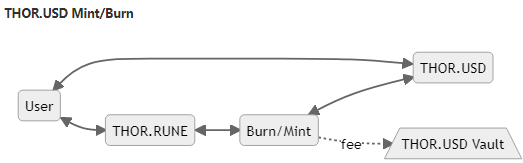
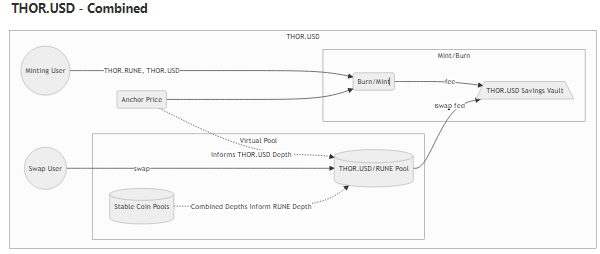
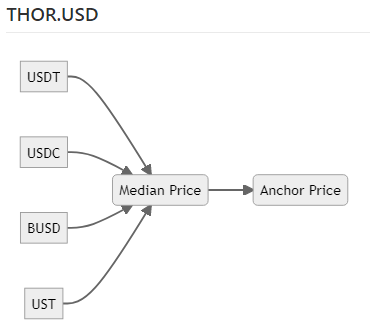
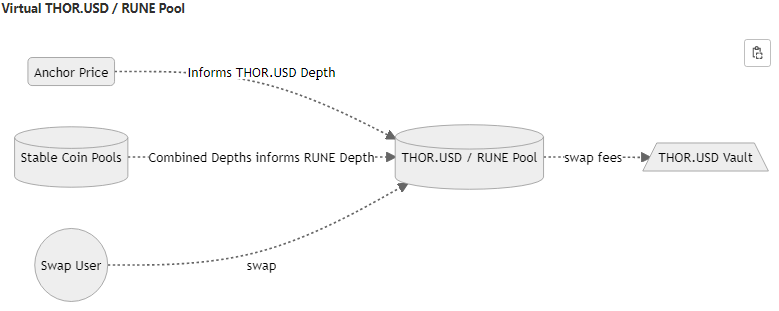
- The anchor price of 1 THOR.USD is determined by the median of the stablecoin pools — USDT, USDC, BUSD, and UST — within THORChain. There is a slip-based fee for minting and redeeming THOR.USD to prevent attack vectors and help to meter demand.
Borrowing:
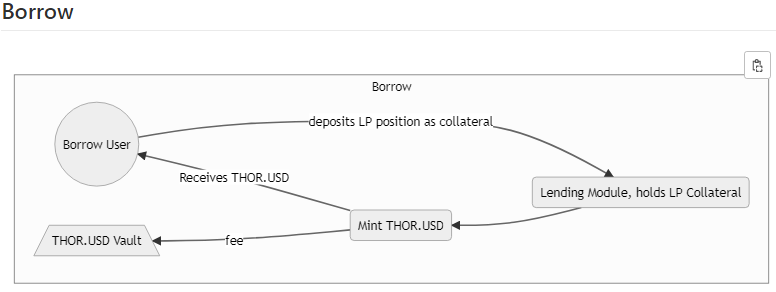
- THORChain users deposit their L1 LP position as collateral (BTC, ETH, LUNA, and other L1 assets) and signal that they wish to give up the yield they were entitled to from being a Liquidity Provider. The LP collateral continues to make the LP pools deeper, incentivizing trading by the nature of deep liquidity/ low slippage, and ultimately driving buying demand for THOR.RUNE.
- All loans must be open for a minimum of 100 days to ensure the network produces yield on this LP collateral. A snapshot is taken at the time you take out your loan, recording your asset deposit value and RUNE deposit value. When the user repays the loan fully, they are subsidized with LP units to the initial deposit amounts of the snapshot.
Collateralization Ratio (CR):
- CR depends on the ratio of pool depth in the LP compared to the loan collateral. The first borrower of THORChain Lending in any specific pool, will get a CR of 100%. This CR will increase as more borrowers start taking loans within each pool according to the Lending design. The higher the CR, the less THOR.USD you are loaned as debt minus fees. As loans are repaid, CR will decrease.
Debt
- Debt is the value of the THOR.USD that is minted and given to the lender based upon the collateral value and CR ratio. If the user swaps THOR.USD into another asset, fees are generated and paid to the THOR.USD Savings vault.
- Formula: LP Collateral value / (CR ratio/100) = Debt minted in THOR.USD
No Liquidations for Loans:
- If your collateral value drops below your debt value, your loan will not be liquidated.
- If your LP collateral value < debt value, economically it doesn’t make sense for a user to repay the debt. This effectively turns the LP collateral into protocol owned liquidity for THORChain until the loan is repaid. This will ensure deep liquidity pools during bear markets or periods of volatility. This LP collateral is yield bearing for the network, collecting block rewards and swap fees from being in the LP.
2 Different LP Collateral Types:
- A user can either lock:
- LP collateral (such as BTC+RUNE for example) and forfeits the LP yield on this.
- Single-sided assets such as BTC, locked into THOR.USD Savings to earn more BTC single-sided with no impermanent loss risk. (This single sided collateral will not be in v1 THORFi.)
THORSavings Interest Accounts Vaults
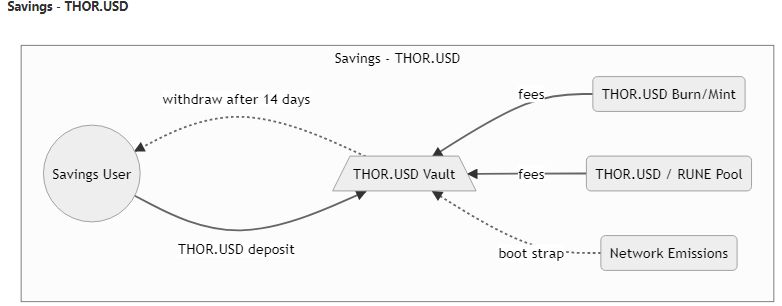
- There are 2 types of Savings vaults that users can use to generate yield. Users can participate by locking in an asset in either vault. There is a 14 adjustable day lock on deposits to prevent mercenary capital from moving to where the yield is highest instantaneously. The user can pick and choose which asset they would like to lock up single sided to earn its respective yield (earning more of the deposited asset).
THOR.USD Savings:
- User deposits THOR.USD and earns THOR.USD based on:
- Swap fees from minting/burning THOR.USD paid out to USD Savers
- Network block rewards
2. Blue-Chip Savings:
- User deposits L1 assets like BTC single sided and earns BTC by:
- Earning yield from BTC LP: swap fees and block rewards (specifically the yield from the borrowers’ collateral)
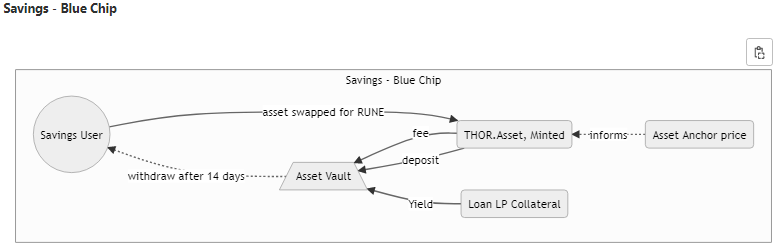
As more users enter THORSavings vaults to earn interest on their assets, this burns $RUNE supply.🔥
Incentive Pendulum:
- There is a current Incentive Pendulum that balances APY between Node operators and LP’s. This switch can incentivize either more liquidity to be added to pools or RUNE bond to be added by Nodes. This helps to push the network into an optimal balance of RUNE bonded vs. liquidity deposited across the network.
- Within THORFi, there is a natural equilibrium that balances the APY between LP’s and THORSavings. Note this is not exactly a second incentive pendulum, but similar in some ways. Initially the THORSavings APY will be large as the first Saver will enjoy all the yields from the corresponding Loan Collateral deposited by the Borrowers. As more Savers deposit into the interest-bearing vaults, the THORSavings APY will drop, so some Savers will withdraw to become a LP instead to chase the higher yield.
Net Effect of Lending on RUNE Supply:
- RUNE supply is burned when acquiring THOR.USD or when someone participates in THORSavings. The supply is increased when THOR.USD is loaned (if the Borrower subsequently uses their borrowed THOR.USD to acquire other assets); however, when a loan takes place, it naturally creates more demand for THORSavings via increasing the yield. Because of this, the act of adding $10k in loan collateral, creates economic pressures to burn at least $10k RUNE value into THORSavings. This means that even with a loan at 100% CR, the RUNE supply is net-neutral. Above 100% CR, the RUNE supply decreases further. The higher the CR, the more the RUNE supply is decreased.
As utilization of Lending increases, RUNE supply will continue to be burnt causing RUNE to become net deflationary. The THORChain tokenomics design continues to capture the value of quality L1 assets in combination with Lending’s burning of RUNE’s supply. Ultimate value accrual. ⚡️
Resources:
- THORFi PDF: https://gitlab.com/thorchain/thornode/-/issues/1255
- Complete Video Guide on THORFi by Grassroots Crypto: https://www.youtube.com/watch?v=qb7NxAbP97U
- THORFi Example Video: https://www.youtube.com/watch?v=1FNrFIXp1xQ&list=LL&index=3&t=1041s
Feel free to hop into the TC University Discord to chat about this, or any other THORChain questions that you may have.
Explore THORChain: Website, X, Telegram, Developer Discord.
Explore Maya Protocol, the first friendly fork of THORChain: Website, X, Discord, Telegram.
Decentralized, permissionless, non-custodial, trust-minimized, open-sourced, economic-secured, non-wrapped, native-to-native cross-chain swaps, savings and soon, lending!

Related articles
![A mint green notification bell glyph on a black key, cover of THORChain's guide to its official channels, podcasts and social media.]()
Oct. 9, 2026
How to Stay Up to Date With THORChain
- Guide
![Zcash (ZEC) logo alongside the THORChain logo, illustrating native ZEC swaps across blockchains on THORChain.]()
Oct. 7, 2026
Bringing Native Zcash to THORChain
- Guide
![boone.tools logo on a dark THORChain background, introducing Boone's collection of THORChain analytics dashboards.]()
Oct. 5, 2026
Introducing boone.tools: A Better Way to Understand THORChain
- Spotlight
- Guide
![THORChain's System Income distribution, with 20% now directed to Protocol-Owned Liquidity and the RUNE burn reduced to 1%.]()
Sep. 23, 2026
How THORChain’s New System Income Distribution Works
- Guide
![Illustration of THORChain's Protocol-Owned Liquidity system, showing System Income flowing into deeper liquidity pools.]()
Sep. 21, 2026
Why Protocol-Owned Liquidity Matters for THORChain
- Guide
![How to Swap Crypto on THORChain thumbnail, a THORChain guide]()
Sep. 18, 2026
How to Swap Crypto on THORChain
- Guide
![THORChain Thumbnail for the 2026 guide comparing ten decentralized exchanges across cross-chain support, fees and MEV protection.]()
Sep. 10, 2026
The 10 Best Decentralized Exchanges (DEXs) in 2026
- Guide
![Thumbnail for THORChain guide explaining how the Advanced Swap Queue and slip-based fees prevent sandwich attacks on swaps.]()
Sep. 7, 2026
How THORChain’s Swap Queue Prevents Sandwich Attacks
- Guide
![THORChain guide thumbnail explaining how to bond RUNE through direct whitelisting, RUNEBond and bRUNE liquid staking, with yield and risk comparisons for each method.]()
Sep. 2, 2026
How to Bond your Rune: a practical guide
- Guide
![THORChain guide thumbnail showing how to perform a cross-chain swap without connecting a wallet, using the Walletless Swap feature on swap.thorchain.org.]()
Aug. 12, 2026
How To: Walletless Swaps
- Guide
![THORChain is transparent even with privacy coins thumbnail.]()
Jul. 21, 2026
THORChain Is Transparent Even With Privacy Coins
- Guide
![THORChain Community Podcast #198 thumbnail featuring JP and Kenton demonstrating the first live decentralised RUNE to Monero swap on THORChain's chainnet.]()
May. 14, 2026
JP Demos Live Monero on THORChain: 7 Nodes, Real Funds, First Swap Works
- Podcast
- Guide
![]()
Apr. 22, 2026
How to read a transaction on THORChain?
- Guide
![]()
Apr. 16, 2026
THORChain’s Native API - plugging liquidity directly to wallets and DEXs
- Guide
![]()
Nov. 26, 2025
Memoless Transactions - THORChain Without Wallet Limitations
- Guide