Under the Hood: Liquidity Pool APR (Synth Leverage) 201

2023-12-20 — 6 min read
- Guide
In Under the Hood: Liquidity Pool APR (Synth Leverage) 101, we discussed how dual asset Liquidity Providers are synth leveraged, and thus it is possible to experience both negative, and also highly positive LP APRs.
TLDR:
- RUNE:Asset price ratio up + Synth utilization high : very good
- RUNE:Asset price ratio up + Synth utilization low : moderate good
- RUNE:Asset price ratio down + Synth utilization low : moderate bad
- RUNE:Asset price ratio down + Synth utilization high : very bad
- If Synths minted (utilization increased) when RUNE:Asset price was low; then Synths burnt (utilization decreased) when RUNE:Asset price was high : good
- If Synths minted (utilization increased) when RUNE:Asset price was high; then Synths burnt (utilization decreased) when RUNE:Asset price was low : bad
In this Part 2 discussion, we will explore how synth leverage is not static, but dynamic, in that synth minting/burning at different price points can greatly influence the profitability or APR of the underlying dual asset LPs.
We will again work through some simplified examples, again intentionally excluding any yield from swaps and slippage during deposit/withdrawals.
Let’s start with the same RUNE:BTC pool example (from 101) below.
Scenario 1 (Savers Deposit)
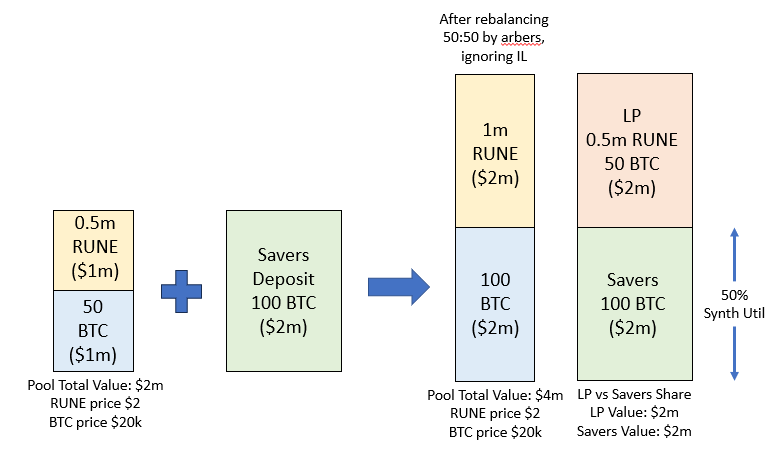
Initially, there are only LPs holding 0.5m RUNE + 50 BTC at the prices indicated ($2 per RUNE & $20k per BTC). Let’s say a user deposits a huge Savers position of 100 BTC, which is then rebalanced into 0.5m RUNE + 50 BTC in the pool, and thus the pool is now 1m RUNE + 100 BTC.
The Saver holds 100 synth BTC, which is always redeemable for 100 native BTC (before slippage), and is backed by 50% of the pool depth. In other words, the Synths Utilization is at 50% of the total pool depth. The LPs hold the other 50% of the pool.
Scenario 2 (RUNE:Asset Price Ratio Decreased)
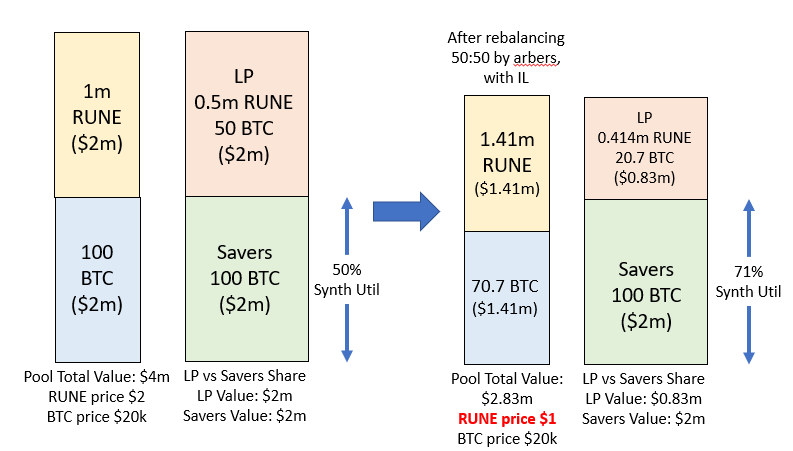
Let’s say RUNE price drops to $1, but BTC price is unchanged, i.e. RUNE:Asset price ratio decreased. Just from arbers rebalancing the pool due to price changes, but still needing to fully back the Savers’ value, the LPs lost a total of 58.5% of their value, from $2m to $0.83m. This consists of 25% actual price loss, 5.7% Impermanent Loss (IL), and 27.8% loss due to Synth Leverage.
In a situation without Synth Leverage, the LPs will only suffer the 25% price loss and 5.7% IL.
Synth Utilization is now 71%. We can see that Synth Utilization can increase without additional Savers deposit (or Synth minting), but just by price movements alone. This explains how Synth Utilization can increase above the Synth Utilization Cap (currently at 60% of LP depth).
Scenario 3 (RUNE:Asset Price Ratio Reverted)
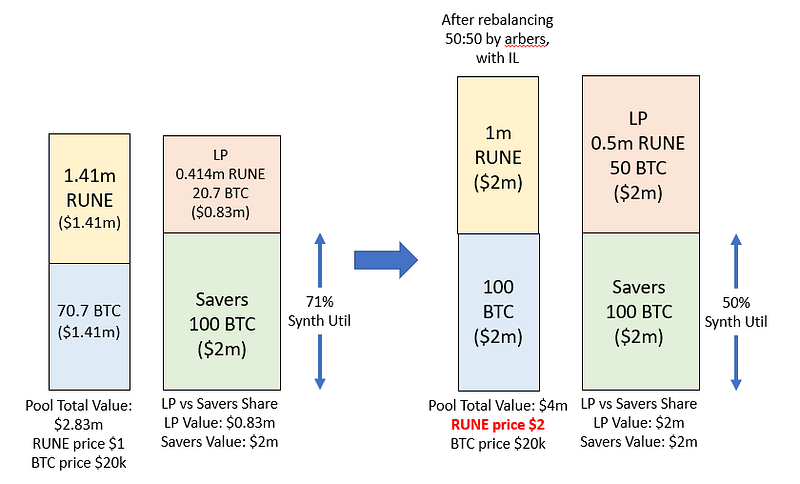
If RUNE price reverts back to $2, the situation reverts back to original, and the LPs are whole again.
Scenario 4 (Savers Withdrawal after RUNE:Asset Price Ratio Decreased)
However, what if when RUNE price was $1 (per Scenario 2), the Saver decides to withdraw half of his position?
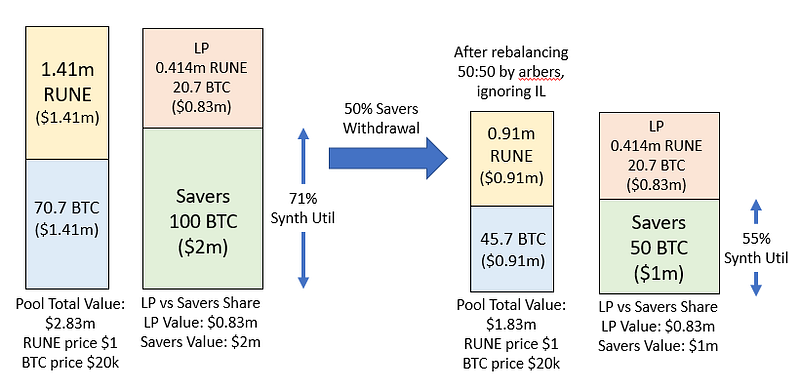
Scenario 5 (RUNE:Asset Price Ratio Reverted after Savers Withdrawal)
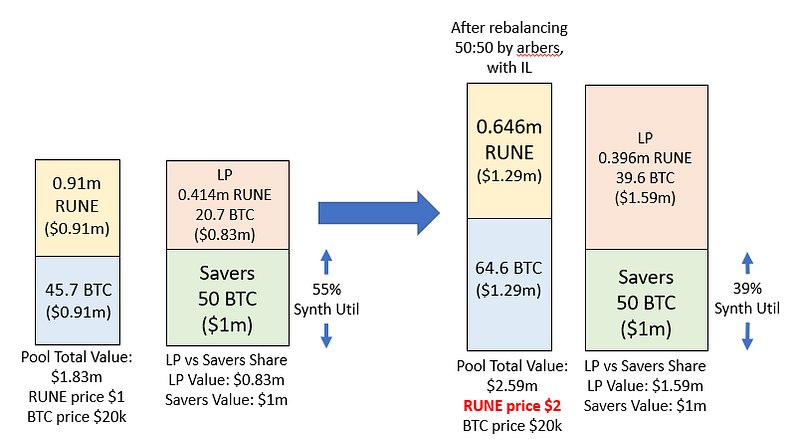
Now, continuing from Scenario 4, let’s say RUNE price reverts back to $2.
Without Synths Leverage, LPs will revert back to their original Scenario 1 initial positions, reversing all their losses, as per Scenario 3.
But with the Savers deposit and withdrawal in-between, the LPs are left with a 20.5% loss, with only $1.59m value, rather than their original $2m value.
In conclusion, it is much more complicated now to calculate/simulate how LP values are impacted by both price movements and synth leverage, since these variables remain dynamic through every single block.
LP on THORChain is now a higher volatility play. If users prefer a lower risk and positive-only APR (excluding slippage), perhaps Savers is the better choice.
But for users who are bullish on RUNE future performance, LP would likely outperform when RUNE:Asset price ratio increases.
Appendix: Real-life Example
As a real-life example, let’s look at the actual AVAX pool between August to the end of 2023.
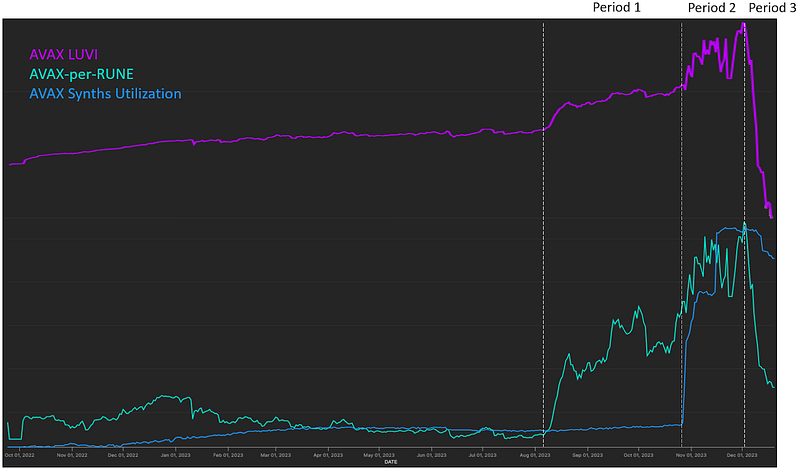
The purple AVAX LUVI line is representative of the LP APR. Higher value means LP is performing better.
The cyan AVAX-per-RUNE line is the price ratio of RUNE:AVAX. Higher value means RUNE price is increasing relative to AVAX price.
The blue AVAX Synths Utilization line is quite self-explanatory. It is the ratio of Synth supply vs pool depth.
Let’s break the analysis into three periods:
Period 1 (early Aug to end Oct 2023):
- Synths Utilization was low.
- AVAX-per-RUNE increased, which meant RUNE price increased relative to AVAX price.
- Therefore, AVAX LUVI (i.e. AVAX LP APR) also increased, with moderate volatility (since the Synths Utilization was low).
Period 2 (end Oct to early Dec 2023):
- Synths Utilization increased significantly.
- AVAX-per-RUNE further increased, which meant RUNE price further increased relative to AVAX price.
- Therefore, AVAX LUVI (i.e. AVAX LP APR) also further increased, with high volatility (since the Synths Utilization was high).
Period 3 (Dec 2023):
- Synths Utilization remained at a high level.
- AVAX-per-RUNE significantly decreased, which meant RUNE price decreased relative to AVAX price.
- Therefore, AVAX LUVI (i.e. AVAX LP APR) decreased significantly.
Overall:
- Part of the RUNE:AVAX price ratio increase happened when Synths Utilization was low, at Period 1; and part of it happened when Synths Utilization was high, at Period 2.
- However, all of the RUNE:AVAX price ratio decrease happened when Synths Utilization was high, at Period 3.
- That was why AVAX LUVI (i.e. AVAX LP APR) decreased more significantly (Dec 2023) vs the increase (Aug to Nov 2023).
- Note that where the charts ended at the end of Period 3, the final AVAX-per-RUNE price was still higher vs the beginning of Period 1; yet the AVAX LUVI (i.e. AVAX LP APR) line was relatively much lower.
Feel free to hop into the TC University Discord to chat about this, or any other THORChain questions that you may have.
Explore THORChain: Website, X, Telegram, Developer Discord.
Explore Maya Protocol, the first friendly fork of THORChain: Website, X, Discord, Telegram.
Decentralized, permissionless, non-custodial, trust-minimized, open-sourced, economic-secured, non-wrapped, native-to-native cross-chain swaps, savings and now, lending!

Related articles
![A mint green notification bell glyph on a black key, cover of THORChain's guide to its official channels, podcasts and social media.]()
Oct. 9, 2026
How to Stay Up to Date With THORChain
- Guide
![Zcash (ZEC) logo alongside the THORChain logo, illustrating native ZEC swaps across blockchains on THORChain.]()
Oct. 7, 2026
Bringing Native Zcash to THORChain
- Guide
![boone.tools logo on a dark THORChain background, introducing Boone's collection of THORChain analytics dashboards.]()
Oct. 5, 2026
Introducing boone.tools: A Better Way to Understand THORChain
- Spotlight
- Guide
![THORChain's System Income distribution, with 20% now directed to Protocol-Owned Liquidity and the RUNE burn reduced to 1%.]()
Sep. 23, 2026
How THORChain’s New System Income Distribution Works
- Guide
![Illustration of THORChain's Protocol-Owned Liquidity system, showing System Income flowing into deeper liquidity pools.]()
Sep. 21, 2026
Why Protocol-Owned Liquidity Matters for THORChain
- Guide
![How to Swap Crypto on THORChain thumbnail, a THORChain guide]()
Sep. 18, 2026
How to Swap Crypto on THORChain
- Guide
![THORChain Thumbnail for the 2026 guide comparing ten decentralized exchanges across cross-chain support, fees and MEV protection.]()
Sep. 10, 2026
The 10 Best Decentralized Exchanges (DEXs) in 2026
- Guide
![Thumbnail for THORChain guide explaining how the Advanced Swap Queue and slip-based fees prevent sandwich attacks on swaps.]()
Sep. 7, 2026
How THORChain’s Swap Queue Prevents Sandwich Attacks
- Guide
![THORChain guide thumbnail explaining how to bond RUNE through direct whitelisting, RUNEBond and bRUNE liquid staking, with yield and risk comparisons for each method.]()
Sep. 2, 2026
How to Bond your Rune: a practical guide
- Guide
![THORChain guide thumbnail showing how to perform a cross-chain swap without connecting a wallet, using the Walletless Swap feature on swap.thorchain.org.]()
Aug. 12, 2026
How To: Walletless Swaps
- Guide
![THORChain is transparent even with privacy coins thumbnail.]()
Jul. 21, 2026
THORChain Is Transparent Even With Privacy Coins
- Guide
![THORChain Community Podcast #198 thumbnail featuring JP and Kenton demonstrating the first live decentralised RUNE to Monero swap on THORChain's chainnet.]()
May. 14, 2026
JP Demos Live Monero on THORChain: 7 Nodes, Real Funds, First Swap Works
- Podcast
- Guide
![]()
Apr. 22, 2026
How to read a transaction on THORChain?
- Guide
![]()
Apr. 16, 2026
THORChain’s Native API - plugging liquidity directly to wallets and DEXs
- Guide
![]()
Nov. 26, 2025
Memoless Transactions - THORChain Without Wallet Limitations
- Guide