1. Savers Vaults Slippage
Update: starting Oct-2023, all Savers deposits & withdrawals are automatically streamed, making the below discussion obsolete.
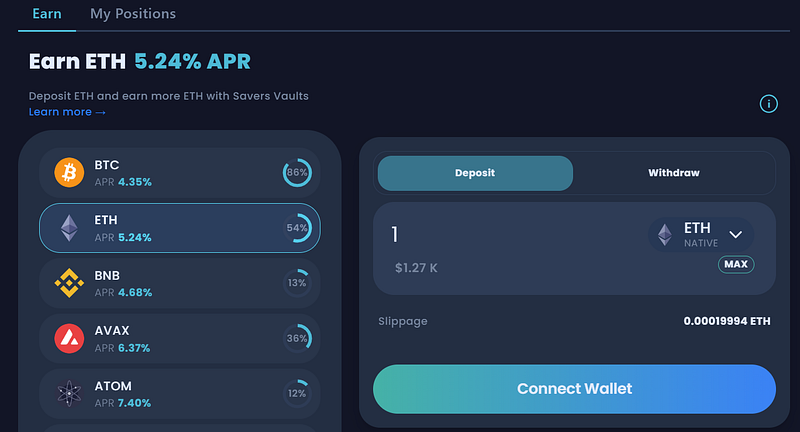
One important consideration is the slippage when depositing and withdrawing from Savers Vaults. One way to check is via THORSwap’s Earn interface (https://app.thorswap.finance/earn). E.g. here is a 1 ETH deposit giving a 0.00019994 ETH slippage, or 0.02% (on the day of writing), as below.
Since the ETH Savers APR is currently around 5.2% (see top left of above screenshot), we can estimate that it will take around 2 days to breakeven for a 0.02% slippage (not considering gas fees).
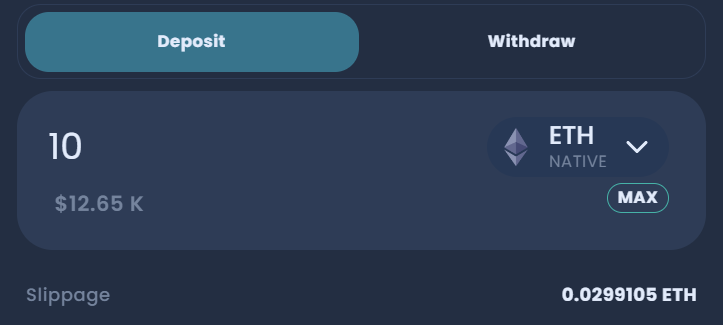
Just for comparison, a 10 ETH deposit is currently incurring a 0.3% slippage (screenshot below), which will need around 21 days for breakeven.
The same estimation should be done for withdrawals too.
Finally, although breaking up deposits and withdrawals into multiple transactions help to reduce slippage, one must be cognizant of the increased gas fees needed as well.
2. Savers Vaults Yield
Update: starting Jun-2023, Savers yield is now calculated on a sliding scale, base on synth utilization depth, making the below discussion obsolete.
Under the hood, the yield for Savers Vaults is accrued in this manner: for every block, the total yield from swaps and block rewards for each pool is calculated, multiplied by the Savers % of the pool, divided into half, and finally accrued into the Savers’ positions. This is what is meant behind “Savers Vaults are earning half the yield vs a normal LP provider”.
This also means the Liquidity Unit Value Index (or LUVI, see next section) APR yield that is displayed for each pool will not be exactly double that of the displayed Savers yield, as the relationship will depend on Savers % and price movement of RUNE:Asset.
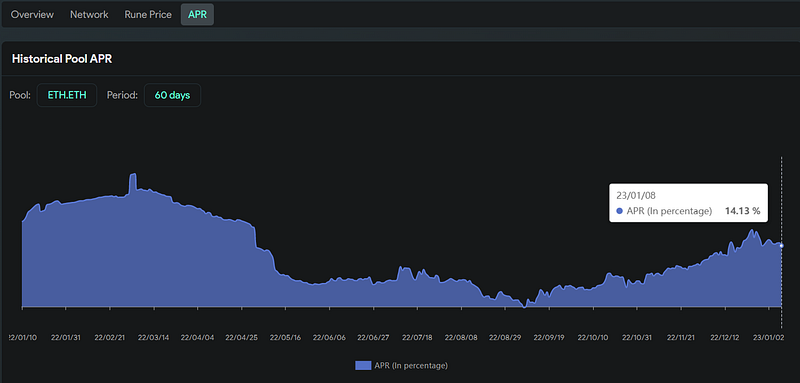
For example, the ETH Savers APR yield currently is 5.2% (as above), while the 60-day LUVI APR yield for the pool is 14.1% (as below), taken from https://thorchain.net/insights/apr.
3. LP LUVI APR Considerations
Many factors play into determining a Liquidity Pool APR: pool depth, swap volume, block emissions, Synths %, Savers %, RUNE:Asset price ratio, APR time-frame calculations, etc.
Firstly, the LP APR is based on Liquidity Unit Value Index (LUVI), which is neglecting the IL portion (https://medium.com/thorchain/introduction-to-luvi-and-midgard-apr-calculation-update-cf15e743276d).
We can view the LUVI yield conceptually in two parts:
Part 1- The swap fees + block rewards always increases the LUVI yield
Part 2- The Synth % leverage
The Synth % of a pool is a “leverage RUNE” effect on the LP. It amplifies the LUVI yield (both positive or negatively) depending on the RUNE:Asset price ratio.
There may be situations where this Part 2 Synth leverage “overpowers” the Part 1 swap fees + block rewards yield, and thus brings an overall negative LUVI change.
So, is higher Synths (Synths + Savers) % good or bad for the LP? The higher the Synths %; the more the LPs earn from Part 1 (since Savers donate half their yield to the LP, while Synths forgo all yield). But the higher the Synths %, the more leveraged is the effect of Part 2.
For example, before when LP alone would have a fluctuation of +/- 5%, due to the increased leverage built on top of it with Savers / Synths, the fluctuation would be exacerbated and might be +/- 10% instead. This can be seen as both positive and negative (depending if it is +10% or -10%) but the higher fluctuation needs to be taken into account.
Note: Entering into a liquidity pool (especially a stablecoin pool) should be thought of carefully. The IL incurred should always be put in relation to the yield you are receiving. E.g. a LUVI yield of 12% with an IL of 14% would still be a net negative.
4. Conclusion
Savers Vaults are now the go-to yield solution for non-RUNE assets, offering no RUNE exposure and no Impermanent Loss.
Liquidity Pools are still an option for advanced users. Just keep in mind that LPs are now more leveraged and thus should expect more volatile yields based on RUNE:Asset price ratio changes.
Feel free to hop into the TC University Discord to chat about this, or any other THORChain questions that you may have.
Explore THORChain: Website, X, Telegram, Developer Discord.
Explore Maya Protocol, the first friendly fork of THORChain: Website, X, Discord, Telegram.
Decentralized, permissionless, non-custodial, trust-minimized, open-sourced, economic-secured, non-wrapped, native-to-native cross-chain swaps, savings and soon, lending!

Related articles
![A mint green notification bell glyph on a black key, cover of THORChain's guide to its official channels, podcasts and social media.]()
Oct. 9, 2026
How to Stay Up to Date With THORChain
- Guide
![Zcash (ZEC) logo alongside the THORChain logo, illustrating native ZEC swaps across blockchains on THORChain.]()
Oct. 7, 2026
Bringing Native Zcash to THORChain
- Guide
![boone.tools logo on a dark THORChain background, introducing Boone's collection of THORChain analytics dashboards.]()
Oct. 5, 2026
Introducing boone.tools: A Better Way to Understand THORChain
- Spotlight
- Guide
![THORChain's System Income distribution, with 20% now directed to Protocol-Owned Liquidity and the RUNE burn reduced to 1%.]()
Sep. 23, 2026
How THORChain’s New System Income Distribution Works
- Guide
![Illustration of THORChain's Protocol-Owned Liquidity system, showing System Income flowing into deeper liquidity pools.]()
Sep. 21, 2026
Why Protocol-Owned Liquidity Matters for THORChain
- Guide
![How to Swap Crypto on THORChain thumbnail, a THORChain guide]()
Sep. 18, 2026
How to Swap Crypto on THORChain
- Guide
![THORChain Thumbnail for the 2026 guide comparing ten decentralized exchanges across cross-chain support, fees and MEV protection.]()
Sep. 10, 2026
The 10 Best Decentralized Exchanges (DEXs) in 2026
- Guide
![Thumbnail for THORChain guide explaining how the Advanced Swap Queue and slip-based fees prevent sandwich attacks on swaps.]()
Sep. 7, 2026
How THORChain’s Swap Queue Prevents Sandwich Attacks
- Guide
![THORChain guide thumbnail explaining how to bond RUNE through direct whitelisting, RUNEBond and bRUNE liquid staking, with yield and risk comparisons for each method.]()
Sep. 2, 2026
How to Bond your Rune: a practical guide
- Guide
![THORChain guide thumbnail showing how to perform a cross-chain swap without connecting a wallet, using the Walletless Swap feature on swap.thorchain.org.]()
Aug. 12, 2026
How To: Walletless Swaps
- Guide
![THORChain is transparent even with privacy coins thumbnail.]()
Jul. 21, 2026
THORChain Is Transparent Even With Privacy Coins
- Guide
![THORChain Community Podcast #198 thumbnail featuring JP and Kenton demonstrating the first live decentralised RUNE to Monero swap on THORChain's chainnet.]()
May. 14, 2026
JP Demos Live Monero on THORChain: 7 Nodes, Real Funds, First Swap Works
- Podcast
- Guide
![]()
Apr. 22, 2026
How to read a transaction on THORChain?
- Guide
![]()
Apr. 16, 2026
THORChain’s Native API - plugging liquidity directly to wallets and DEXs
- Guide
![]()
Nov. 26, 2025
Memoless Transactions - THORChain Without Wallet Limitations
- Guide