Under the Hood: Savers Vaults & Protocol Owned Liquidity

2022-09-01 — 4 min read
- Guide
Savers Vaults (or Single Sided Yield, or Single Sided LP) and Protocol Owned Liquidity on THORChain: how do these features work?
First, we need to understand how THORChain Synthetics (or Synths) work. There are many resources (e.g. https://medium.com/thorchain/activation-of-synthetics-5064e0f43301), but tl/dr: minting a Synth essentially deepens the respective liquidity pool (LP) to an equal value, split into 50:50 Asset:RUNE.
Before this, only arbers were holding Synths since there was no yield. But the Savers Vaults design will create a mechanism where users can deposit native gas assets (e.g. BTC, ETH, BNB; all auto converted into Synths) to earn yield, which would be 50% of the earnings earned by the respective LP.
Savers Vaults:
- are backed by the respective LP
- earn a part of the yield from swap fees using THORChain LPs
- are always redeemable (with slippage) to the native coin
- have no RUNE price exposure
- have no impermanent loss exposure
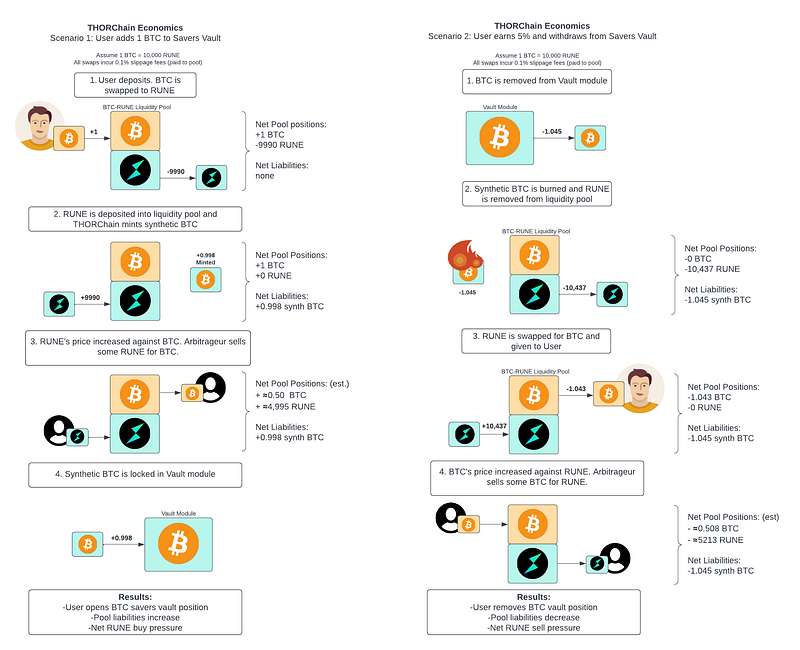
Here is an overview/example of depositing & withdrawing from Savers Vaults:
Protocol Owned Liquidity (POL)
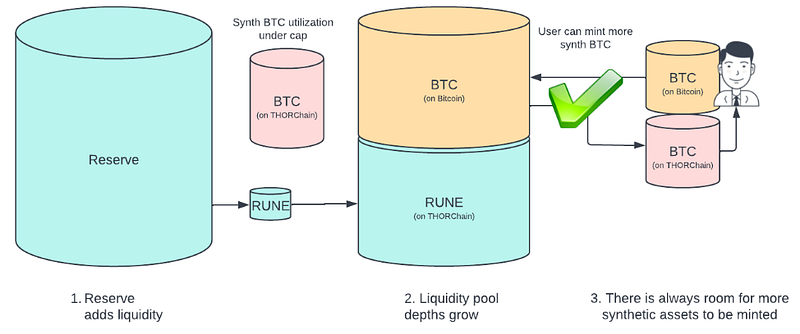
The expectation is that Synths, because of their multifaceted appeal, may quickly reach their utilization limit (at the time of writing, at maximum 60% of LP depth), as users mint Synths to enjoy the Savers Vaults.
Enter: Protocol Owned Liquidity (POL). The THORChain Reserves will deposit RUNE into the LPs if the Synth utilization for each pool reached >50% of LP depth. This will deepen the pools, and thus reduce the % of Synth utilization per pool, allowing for more Synths to be minted.
Conversely, the POL RUNE will be withdrawn from the LPs if the Synth utilization for each pool reached <40% of LP depth. POL will neither be deposited not withdrawn when Synth utilization resides between 40 to 50% of LP depth. [Update: starting Nov-2023, POL withdraw trigger will be at 10% Synth utilization. Deposit trigger unchanged at 50% Synth utilization.]
The amount of POL RUNE contributed at the feature’s outset will be limited to a small % of total Reserves, and will be gradually increased over time to battle test these features. In theory, the amount of POL will be limited by the hard cap (i.e. total pooled RUNE = total bonded RUNE by the lowest 67% of nodes). In practice, as POL grows the pools → the Incentive Pendulum will favor the nodes over the LPs → Synths yield decrease → users redeem Synths back to native coins → Synths % decrease → Reserves remove POL → equilibrium reached.
The flexibility of always creating space for more Synths (via the POL) is also a key enabler for the future Order Book feature, as pending limit orders are held by the protocol in the form of Synths.
FAQ:
1. Will the Savers Vaults be offered for all assets, including native RUNE?
No. Savers Vaults will only be offered for gas assets of each external blockchain (BTC, ETH, BNB, BCH, DOGE, LTC, ATOM, AVAX), and not for native RUNE. In the future, certain non-gas assets (e.g. stablecoins) may be considered for Savers Vaults.
2. Will Savers Vaults reduce demand for native RUNE?
No. Savers Vaults means minting/holding Synths, which will be split into 50:50 Asset:RUNE in the LP. Therefore, a user minting Synths with assets will drive buy pressure for RUNE.
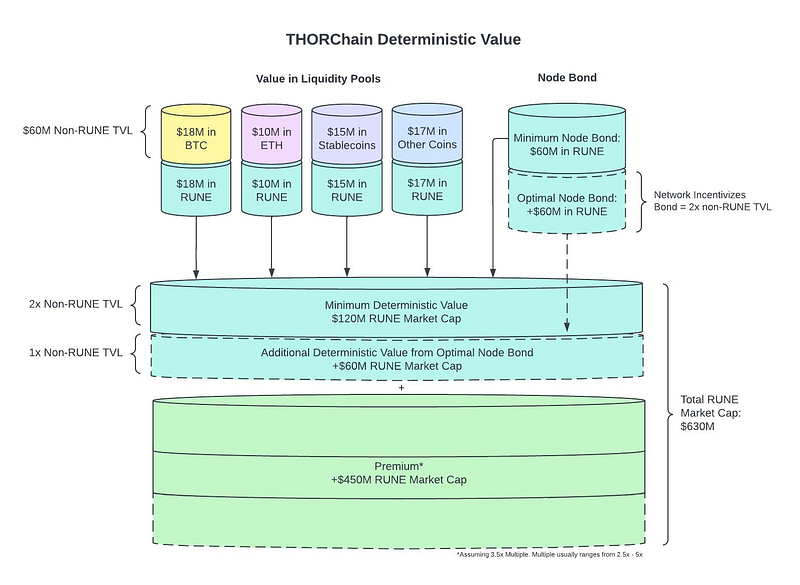
3. Will Savers Vaults negate the 3x non-RUNE TVL deterministic pricing?
The additional dynamics of Savers Vaults and POL may mean the target Incentive Pendulum of 2 bonded RUNE : 1 pooled RUNE may not be the equilibrium anymore. However, the hard cap will ensure a minimum deterministic pricing of 2x non-RUNE TVL. Time will tell, but it could be that an equilibrium deterministic pricing will float between 2 to 3x non-RUNE TVL.
4. How does Savers Vaults benefit THORChain?
As depositors of Savers Vaults are technically holding Synths behind the scenes, this is deepening the LPs → reducing slippage for traders → increasing swap volume → increasing fees collected → increasing users deposit to chase the yields → liquidity black hole.
5. What are the risks of Savers Vaults?
The main risk is, as always, protocol risk (code exploits, etc.) of the THORChain protocol itself. Also, there is a risk of experiencing high slippage, which is dependent on deposit/withdrawal size:: liquidity pool depth ratio.
Github:
Savers Vaults: https://gitlab.com/thorchain/thornode/-/issues/1342
Orderbooks: https://gitlab.com/thorchain/thornode/-/issues/1364
Feel free to hop into the TC University Discord to chat about this, or any other THORChain questions that you may have.
Explore THORChain: Website, X, Telegram, Developer Discord.
Explore Maya Protocol, the first friendly fork of THORChain: Website, X, Discord, Telegram.
Decentralized, permissionless, non-custodial, trust-minimized, open-sourced, economic-secured, non-wrapped, native-to-native cross-chain swaps, savings and soon, lending!

Related articles
![A mint green notification bell glyph on a black key, cover of THORChain's guide to its official channels, podcasts and social media.]()
Oct. 9, 2026
How to Stay Up to Date With THORChain
- Guide
![Zcash (ZEC) logo alongside the THORChain logo, illustrating native ZEC swaps across blockchains on THORChain.]()
Oct. 7, 2026
Bringing Native Zcash to THORChain
- Guide
![boone.tools logo on a dark THORChain background, introducing Boone's collection of THORChain analytics dashboards.]()
Oct. 5, 2026
Introducing boone.tools: A Better Way to Understand THORChain
- Spotlight
- Guide
![THORChain's System Income distribution, with 20% now directed to Protocol-Owned Liquidity and the RUNE burn reduced to 1%.]()
Sep. 23, 2026
How THORChain’s New System Income Distribution Works
- Guide
![Illustration of THORChain's Protocol-Owned Liquidity system, showing System Income flowing into deeper liquidity pools.]()
Sep. 21, 2026
Why Protocol-Owned Liquidity Matters for THORChain
- Guide
![How to Swap Crypto on THORChain thumbnail, a THORChain guide]()
Sep. 18, 2026
How to Swap Crypto on THORChain
- Guide
![THORChain Thumbnail for the 2026 guide comparing ten decentralized exchanges across cross-chain support, fees and MEV protection.]()
Sep. 10, 2026
The 10 Best Decentralized Exchanges (DEXs) in 2026
- Guide
![Thumbnail for THORChain guide explaining how the Advanced Swap Queue and slip-based fees prevent sandwich attacks on swaps.]()
Sep. 7, 2026
How THORChain’s Swap Queue Prevents Sandwich Attacks
- Guide
![THORChain guide thumbnail explaining how to bond RUNE through direct whitelisting, RUNEBond and bRUNE liquid staking, with yield and risk comparisons for each method.]()
Sep. 2, 2026
How to Bond your Rune: a practical guide
- Guide
![THORChain guide thumbnail showing how to perform a cross-chain swap without connecting a wallet, using the Walletless Swap feature on swap.thorchain.org.]()
Aug. 12, 2026
How To: Walletless Swaps
- Guide
![THORChain is transparent even with privacy coins thumbnail.]()
Jul. 21, 2026
THORChain Is Transparent Even With Privacy Coins
- Guide
![THORChain Community Podcast #198 thumbnail featuring JP and Kenton demonstrating the first live decentralised RUNE to Monero swap on THORChain's chainnet.]()
May. 14, 2026
JP Demos Live Monero on THORChain: 7 Nodes, Real Funds, First Swap Works
- Podcast
- Guide
![]()
Apr. 22, 2026
How to read a transaction on THORChain?
- Guide
![]()
Apr. 16, 2026
THORChain’s Native API - plugging liquidity directly to wallets and DEXs
- Guide
![]()
Nov. 26, 2025
Memoless Transactions - THORChain Without Wallet Limitations
- Guide